
What is Myofascial Release? (MFR)
Myofascial Release, or MFR, is a safe and gentle form of hands on bodywork that helps reduce or eliminate pain, improve posture, increase range of motion, reset the nervous system, and release tissue memory by addressing the patterns of myofascial restriction in your body. MFR never forces, and therefore can never injure! Treatment consists of gentle sustained pressure into the fascial restrictions and is based on scientific principles and physics.
Structurally, putting uninterrupted pressure (piezoelectricity or “pressure electricity”) and gentle tension (“mechanotransduction”) into the system initiates “phase transition” into the tissue, literally melting the restrictions (“release”), allowing the areas that have become dense and tight to regain fluidity and achieve “resonance” in a balanced and flexible state. It is actually similar to the way our touch screen devices work as the gentle pressure/electrical connection of your finger creates change on the screen, but in the body during treatment this process takes a minimum of 3-5 minutes to begin and begins a sustainable, gentle cascade of three dimensional change.
The art of “waiting at the barrier” (where the body begins to feel apprehensive about letting go of a self-created safety measure), not only invites spaciousness and mobility in the structure, but allows the powerful mind to relax its fearful grip on maintaining the status quo. The brain, which operates based on prior experience, can be reluctant to allow change, preferring the devil it knows (pain) to what could potentially be worse (the unknown). Calming and resetting the nervous system by allowing the body to choose to change fosters deep relaxation, reduces anxiety, defuses triggers, and allows the mindful processing and resolution of restrictions based on deep seated tissue memory.
Other modalities address merely the elasto-muscular component of the tissue, missing this essential time element that gently allows the fascial web to open without forcing; this is why they cannot provide lasting change. Talk therapy does not engage the body structure to address the physical echoes of stored trauma (I.e. tissue memory). MFR, at its best, is authentic Mind-body Healing!
The art and science of MFR is using focus, patience, time and sustained pressure to release the fascia and free you from the symptoms manifested by the tightened protective web in your mind AND body!
Are you ready to feel better?

This drawing of a sweater illustrates what happens when an area of fascia becomes dense and tight as a protective response. Pulling a thread (tightening) in one part of the garment (fascial “web”) distorts the entire sweater. In your body, fascial restrictions are indiscriminate and three dimensional. Their only mission is to protect by reinforcing, no matter what’s in the way. When an area within this web of soft tissue binds down and hardens, it produces a drag-like effectthroughout the entire body, easily compressing or pulling joints out of alignment, impinging nerves, triggering a fight/ flight response, constricting muscles, compromising normal organ function, suffocating cells, or producing symptoms away from the restricted area or pain in areas you might not expect!
NONE of the standard tests, including X-Ray, Myleograms, EMG, and CAT scans show fascial restrictions. It is thought that an extremely high percentage of people suffering with pain and/or reduced range of motion have fascial-based issues!
What is Fascia
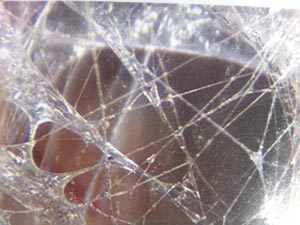
The fascia is a connective tissue that has an appearance similar to a dewy spider’s web. In its optimal state it is flexible, fluid-filled, and infinitely adaptable in three dimensions, a single matrix that exists body wide without interruption. It touches and connects every single cell, providing a body wide communication system. At the cellular level it is responsible for cell health and inter-cell communication. On a broader scale, it connects tissue fibers together to create muscles and organs, and at a most familiar level, sheaths of fascia provide boundaries in the body, like muscle group coverings and body cavity linings. (Since muscle tissue is defined by fascia, this is why massage and stretching modalities produce temporary results- You cannot effectively change the tone of a muscle without reshaping the matrix that defines it.)
When the fascia senses a trauma, it goes into protective mode, loses its natural state of adaptable fluidity, tightens, and solidifies, which is called a “restriction” . Injury, stress, trauma, repetitive motion, inflammatory responses, and/or surgical procedures may create myofascial restrictions. Restrictions can form in any direction within us, often producing symptoms distant from the actual issue. Fascia is plastic in nature, and unless released, restrictions will continue to spread and tighten in compensation patterns, creating a “straightjacket” of pain and limited motion.
For a remarkable video of living fascia, including releases, click here : Warning: this video shows internal body structures and an open surgical site.
I invite you to watch both the videos below. One is by Gil Hedley and is entertaining and informative.
The other is by Richard Harty explaining what Myofascial Release is and how it works.
The Fuzz Speech: Gil Hedley, Leader of Integral Anatomy expeditions of the human form in his innovative whole body, layer by layer approach to the study of anatomy speaks simply to the role of fascia, aka "The Fuzz", in our everyday patterns of movement and how stretching affects the fascial system.. (5 min)
“What if it turns out better than you can possibly imagine?”
This video by Richard Harty is about Myofascial Release and how it works.